

CV – Research – Lab members – Publications
 Dr. Emmanuel Marquez Legorreta
Cell Biology, Neurobiology and Biophysics,
Faculty of Science, Utrecht University
Kruytgebouw, room N511
Padualaan 8, 3584 CH Utrecht
The Netherlands
e-mail: e.marquezlegorreta@uu.nl
Curriculum Vitae
Emmanuel Marquez Legorreta began his neuroscience career studying the neuroanatomy of the auditory system under Dr. Enrique Saldaña at the Institute of Neurosciences of Castilla y León (INCyL), where he characterized the connections and cytoarchitecture of rat auditory subcortical nuclei.
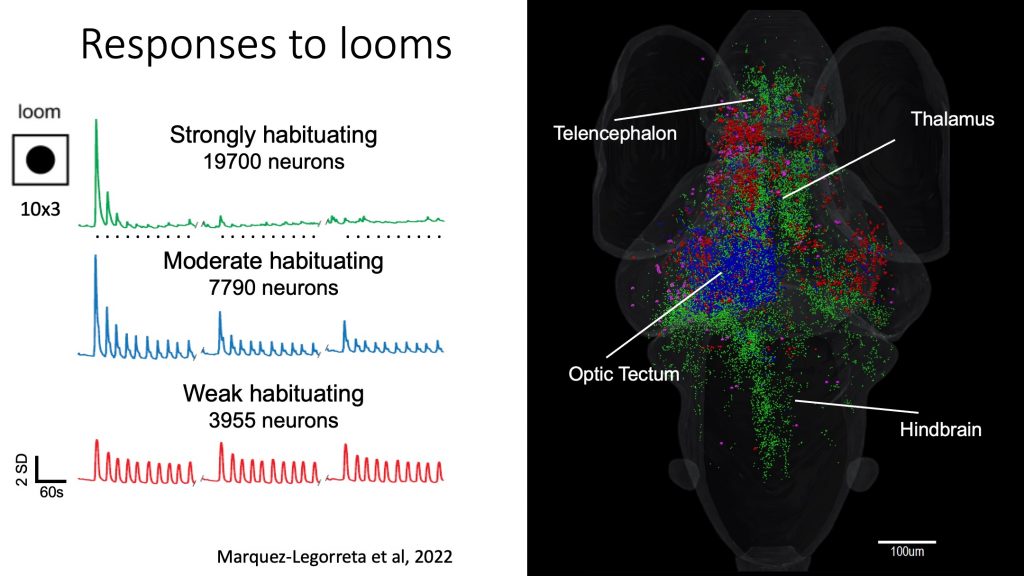
In 2015 he moved to The University of Queensland for his PhD, where he studied visual learning in fish. First investigating reef-fish vision using operant conditioning with Dr. Ulrike Siebeck, then analyzing whole‑brain visual habituation in zebrafish larvae in Ethan Scott’s lab.
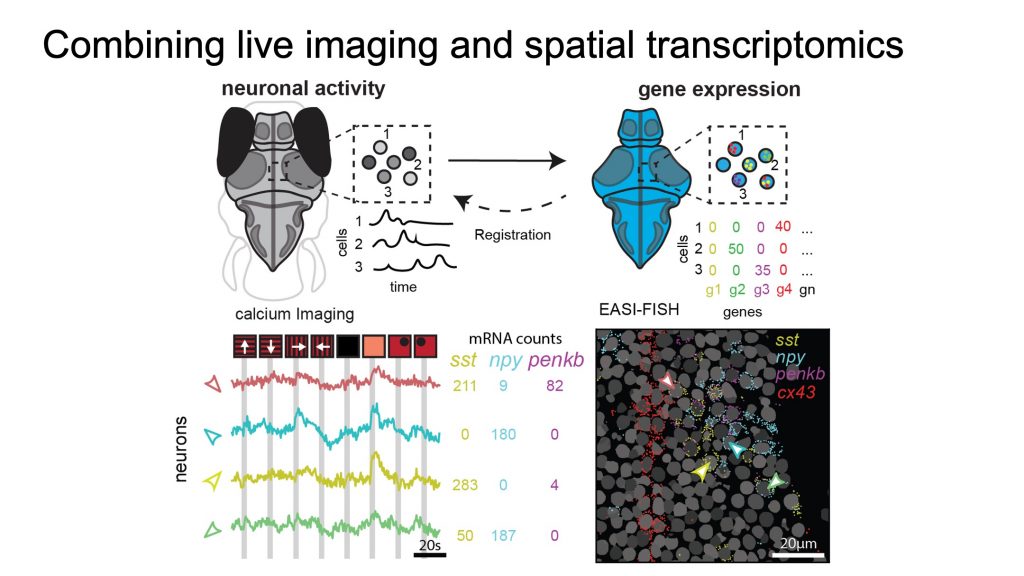
In 2021 Emmanuel joined Misha Ahrens’ lab at the Janelia Research Campus, contributing to a multidisciplinary effort that developed and optimized methods for combining whole-brain calcium imaging with multiplexed in situ hybridization using expansion microscopy.
He began as Assistant Professor of Molecular and Cellular Neurobiology in the Department of Biology at Utrecht University in 2025, where his research focuses on innate behaviors in larval zebrafish.
A pdf of a short CV can be found here.
Research summary
Species behavioral diversity arises through evolution, producing adaptations to the specific demands of different environments. Innate behavioral repertoires are an especially informative type of adaptation because they reflect species‑specific brain organization.
Neuroethology studies natural behaviors and the neuronal circuits that produce them, but studying brain‑wide activity of these behaviors has been difficult in most species. Larval zebrafish overcome this barrier: their small size, rapid development, and optical transparency enable whole‑brain, single‑cell resolution imaging and high‑throughput monitoring of neuronal activity in animals actively responding to ethologically relevant stimuli. This allows to study innate behaviors in a comprehensive manner, as it is possible to simultaneously integrate neuronal responses across multiple brain structures.
The lab currently focuses on the circuits underlying predator avoidance behaviors. Detecting threats and generating appropriate defensive responses are essential for survival, so many animals are born with the neural machinery to react immediately. Larval zebrafish can display predator avoidance behaviors within days of hatching, providing an ideal model to dissect these circuits using available optical and genetic tools.
We will use whole‑brain calcium imaging to identify neuronal populations involved in detection and avoidance, characterize how they process sensory information, and determine how their activity drives the resulting behaviors.
We will also use optimized methods of Expansion Microscopy to investigate the gene expression profile of the neurons involved in predator avoidance. These methods can be combined with the neuronal activity experiments which will allow us to differentiate specific subpopulations of neurons and identify their role in these innate behaviors.
The lab will also study the neural basis of predator avoidance by integrating behavioral assays to quantify stimulus‑response relationships and ethologically relevant outputs, and neuroanatomical methods to trace connectivity and circuit architecture.
In the future, we will also include comparative neuroscience approaches to elucidate evolutionary mechanisms that guide nervous system variability and the behavioral repertoires they enable.
Lab members
Publications
Link to ORCID.
2025
Chen AB, Duque M, Rymbek A, Dhanasekar M, Wang VM, Mi X, Tocquer L, Narayan S, Marquez-Legorreta E, Eddison M, Yu G, Wyart C, Prober DA, Engert F, Ahrens MB. (2025). Norepinephrine changes behavioral state through astroglial purinergic signaling. Science 388,769-775(2025).DOI:10.1126/science.adq5233
2024
Zocchi D, Nguyen M, Marquez-Legorreta E, Siwanowicz I, Singh C, Prober DA, Hillman EMC, Ahrens MB. (2024). Days-old zebrafish rapidly learn to recognize threatening agents through noradrenergic and forebrain circuits. Current Biology, 35(1):163-176.e4. doi: 10.1016/j.cub.2024.11.057.
2022
Marquez-Legorreta E, Constantin L, Piber M, Favre-Bulle IA, Taylor MA, Blevins AS, Giacomotto J, Bassett D, Vanwalleghem GC, and Scott EK. (2022). Brain-wide visual habituation networks in wild-type and fmr1 zebrafish. Nat Commun 13, 895; doi: https://doi.org/10.1038/s41467-022-28299-4
2021
*Mancienne, T., *Marquez-Legorreta, E., Wilde, M., Piber, M., Favre-Bulle, I., Vanwalleghem, G., & Scott, E. K. (2021). Contributions of Luminance and Motion to Visual Escape and Habituation in Larval Zebrafish. Frontiers in neural circuits, 15, 748535. https://doi.org/10.3389/fncir.2021.748535. *Denotes equal contribution
Isa, T., Marquez-Legorreta, E., Grillner, S., & Scott, E. K. (2021). The tectum/superior colliculus as the vertebrate solution for spatial sensory integration and action. Current biology: CB, 31(11), R741–R762. https://doi.org/10.1016/j.cub.2021.04.001
2020
Favre-Bulle, IA, Taylor, MA, Marquez-Legorreta, E, Vanwalleghem G, Poulsen, RE, Rubinsztein-Dunlop, H and Scott, EK. Sound generation in zebrafish with Bio-Opto-Acoustics. Nat Commun 11, 6120 (2020). https://doi.org/10.1038/s41467-020-19982-5
Marquez-Legorreta E, Piber M, and Scott EK. (2020) Visual Escape in Larval Zebrafish: Stimuli, Circuits, and Behavior. In: Behavioral and Neural Genetics of Zebrafish. Elsevier.
2016
Marquez-Legorreta E, Horta-Junior JAC, , Berrebi AS, Saldaña E (2016) Organization of the Zone of Transition between the Pretectum and the Thalamus, with Emphasis on the Pretectothalamic Lamina. Frontiers in Neuroanatomy. doi: 10.3389/fnana.2016.00082