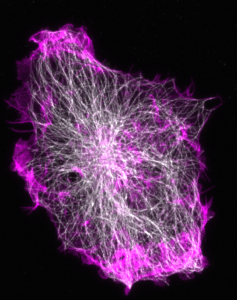
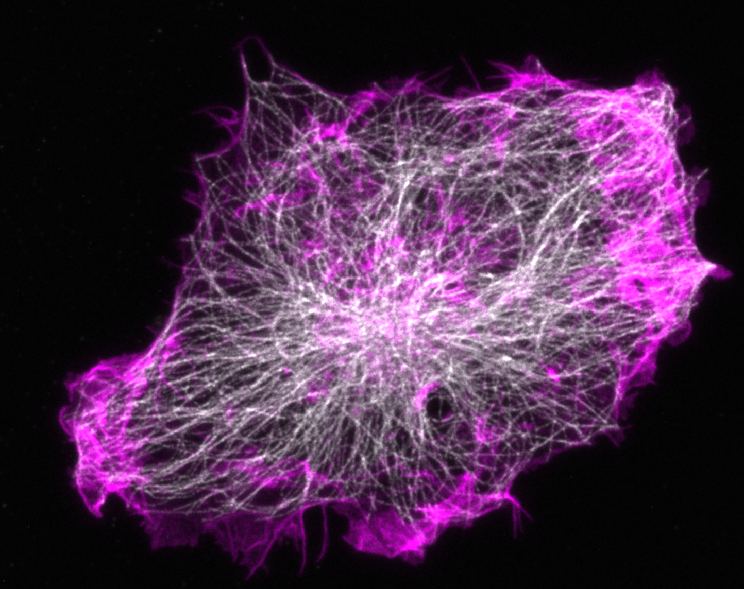
Taxane-induced conformational changes in the microtubule lattice activate GEF-H1-dependent RhoA signalling.
Meiring JCM, Mahapatra V, Liu R, Gravett MSC, Morren D, Saunders HAJ, Choi SR, Pelster José A, Karhanova A, Metallidou I, Moore A, Spoelstra MFM, Grigoriev IS, Giono M, Iyer SS, Stehbens SJ, Díaz JF, Lansky Z, Stecker KE, Steinmetz MO, Howes SC, Kapitein LC, Akhmanova A. Nature Cell Biology (2026). DOI: 10.1038/s41556-026-02079-4.
Taxanes are widely used chemotherapeutic agents that perturb cell division. They also exert effects during interphase, but the underlying mechanisms are poorly understood. Here we show that taxanes activate RhoA signalling and induce actin remodelling by releasing the RhoA activator GEF-H1 from microtubules. This taxane-induced release of GEF-H1 occurs rapidly, is independent of tubulin post-translational modifications, and can be recapitulated using purified proteins. In vitro reconstitution assays combined with analyses of microtubule structure revealed that microtubule binding by GEF-H1 is inhibited by microtubule-stabilizing ligands that expand the microtubule lattice, such as taxanes and GMPCPP, but not by others, including GTPγS and discodermolide, which stabilize a compacted microtubule lattice. Our findings demonstrate that alterations in microtubule lattice conformation can activate key signalling pathways, offering insights into the mode of action of taxanes and the possible origins of their side effects.
Click here for the full article.